January 3, 2025
Starting conversations about climate change is an essential step to building a sustainable and resilient community. Yet, many people living in rural communities can find conversations about the effects of climate change difficult to have because they can be seen as divisive, political, and potential sources of conflict.
Led by a conservation district, a regional museum, and university researchers, the Climate and Rural Systems Partnership (CRSP) was designed to break down that silence. Working in a rural community in Pennsylvania, the partnership began by developing a regional network to co-develop strategies to support conversations about climate change and its local impacts. Drawing on local organizations and leaders including land management, watershed stewards, parks staff, utility directors and staff, farmers, educators, and community gardeners, the network came together in regular meetings to share their experiences and perspectives and to co-design new educational experiences. Early conversations coalesced around topics relevant to the area, such as agricultural practices, stormwater management, and gardening/local food.
The network then co-created a climate card tool. The cards have pictures and text featuring local examples of climate change impacts and solutions. They are designed to support friendly conversations that begin from the interests of learners, rather than solely focusing directly on the work of the organization. They are also designed to provide a way to discuss how climate change connects to both the participant's and the facilitator's life and work and can be customized to work across different kinds of informal and formal settings.
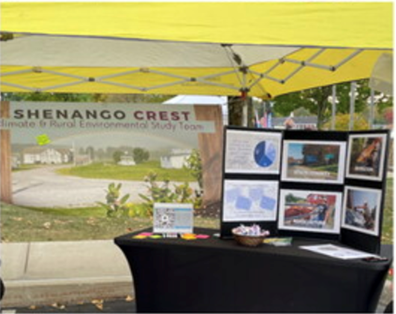
The university researcher, Mary Ann Steiner, supported pop up informal learning experiences led by network members, using the climate card tool at a public night market, a community-college canning workshop, and with high-school Envirothon teams. The cards and facilitation approaches were aligned with local knowledge and interest and provided just enough information to introduce a discussion topic with being too didactic. Across these events, Steiner, and her colleagues, Karen Knutson and Kevin Crowley saw a wide range of reactions to climate change.
By using climate cards, the network aimed to shift the conversation from the typical lecture-based style of discussion of climate change to a more collaborative approach. The open-ended nature of the cards invited members of rural communities to share their knowledge and experiences about local issues with each other.
Creating a space to have respectful conversations about topics that often cause conflict can be intimidating. Climate cards can provide support for rural educators to create and customize learning experiences for different interests, lived experiences, and values.
The full paper can be found at Connected Science Learning.
Steiner, M.A., Knutson, K., & Crowley, K. (2024). Time to talk: Facilitating clime change conversations in rural Pennsylvania. Connected Science Learning.
Written by Amber Eschrich