January 12, 2026
Key Recommendations:
- Maintain collaboration with the community and other stakeholders at every stage in the research process
- Evaluate the program using both standardized and culturally relevant measures
- Consider the challenges of customizing for one group vs. generalizing across different groups
- Test strengths-based approaches against other intervention approaches
- Secure supplemental funds for this work (recommendations do not need to be adopted all at the same time).
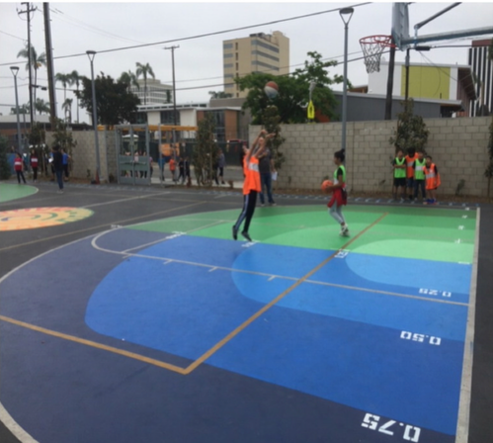
basketball court with number line
Recently, researchers have advocated for adopting a strengths-based approach to investigate the academic and socio-emotional development of historically minoritized and linguistically diverse students. However, there is little guidance on how to apply this approach in practice.
In this study, LRDC Research Scientist Diana Leyva and her co-authors outline a theoretical framework and key principles underlying a strengths-based approach. They illustrate how to apply this approach in various stages of the research process, from program design and evaluation to result interpretation and dissemination, using three examples from recent Randomized controlled trials (RCTs). These examples have successfully enhanced educational outcomes for kindergarten, elementary, and middle school students of Latino and African American backgrounds. Rather than focusing solely on deficits, risks, or average treatment effects, the authors argue that RCTs can be designed and analyzed to identify and leverage participants' existing assets, capacities, and contextual supports.
The authors discuss analytic strategies that highlight heterogeneity, subgroup strengths, and positive deviance, while still maintaining the rigor and causal inference advantages of randomization and offer five recommendations for education researchers (see above).
Read the full article at Taylor and Francis Online.